
Marshall County Deed Types
The Register of Deeds records warranty, quitclaim, correction, estate, trustee, sheriff, and tax deeds. Mortgages and liens land there too. Releases, assignments, mechanics liens, tax liens, fixture filings, and county-filed UCC material round out the books. Each instrument type carries its own legal function. So the label on a recorded document matters.
| Deed Type | What It Does | Common Use |
|---|---|---|
| Warranty deed | Conveys title with covenants | Ordinary sale |
| Quitclaim deed | Conveys whatever interest exists | Interest cleanup |
| Correction deed | Corrects a recorded defect | Name or description correction |
| Executor or trustee deed | Conveys through a fiduciary | Estate or trust transfer |
| Sheriff or tax deed | Conveys through legal process | Foreclosure or tax proceeding |
A mortgage records a security interest rather than a transfer of ownership. A lien works the same way. Always pull the release or assignment that follows it. An old lien without its satisfaction leaves a Marshall County chain looking worse than it really is.
Use Marshall County Grantor-Grantee Books
The office keeps daily index books and computerized ownership records reaching back to 1987. There is no remote deed-image portal. Marshall County deed research therefore runs through courthouse inspection, phone calls, email, and written requests. Plan your visit accordingly.
- Start with the present owner's deed reference from CAMA or the latest index entry.
- Retrieve it and record the grantor, grantee, date, type, book/page, and legal description.
- Search that grantor as a prior grantee to find the acquiring deed.
- Repeat while the land remains matched, moving into paper books before 1987.
- Grantor
- The party conveying an interest.
- Grantee
- The party receiving an interest.
- Chain of title
- The linked sequence of recorded transfers.
- Book and page
- The volume reference used to retrieve an instrument.
Order a Marshall County Deed Copy
The Register of Deeds sits at 1201 Broadway in Marysville, and you can also call 785-562-3226, email rmartin@mscoks.org, or mail a written request. Spell out names, an approximate date, the instrument type, book and page if known, and the exact legal description. Ask which fits. A plain copy suits reference, while a certified copy serves official use. Request a fee estimate either way.
Recorded, not guaranteed. Marshall County deed records show filed instruments, not a title opinion. Unrecorded interests and indexing errors may require professional review.
The Marshall County 1987 Handoff
Computerized ownership records in Marshall County start in 1987. Anything older lives in paper daily indexes and deed books. Keep a worksheet listing each party, recording date, deed type, book and page, and a matching legal description. The Register of Deeds page spells out the public-inspection and computerized-record details.
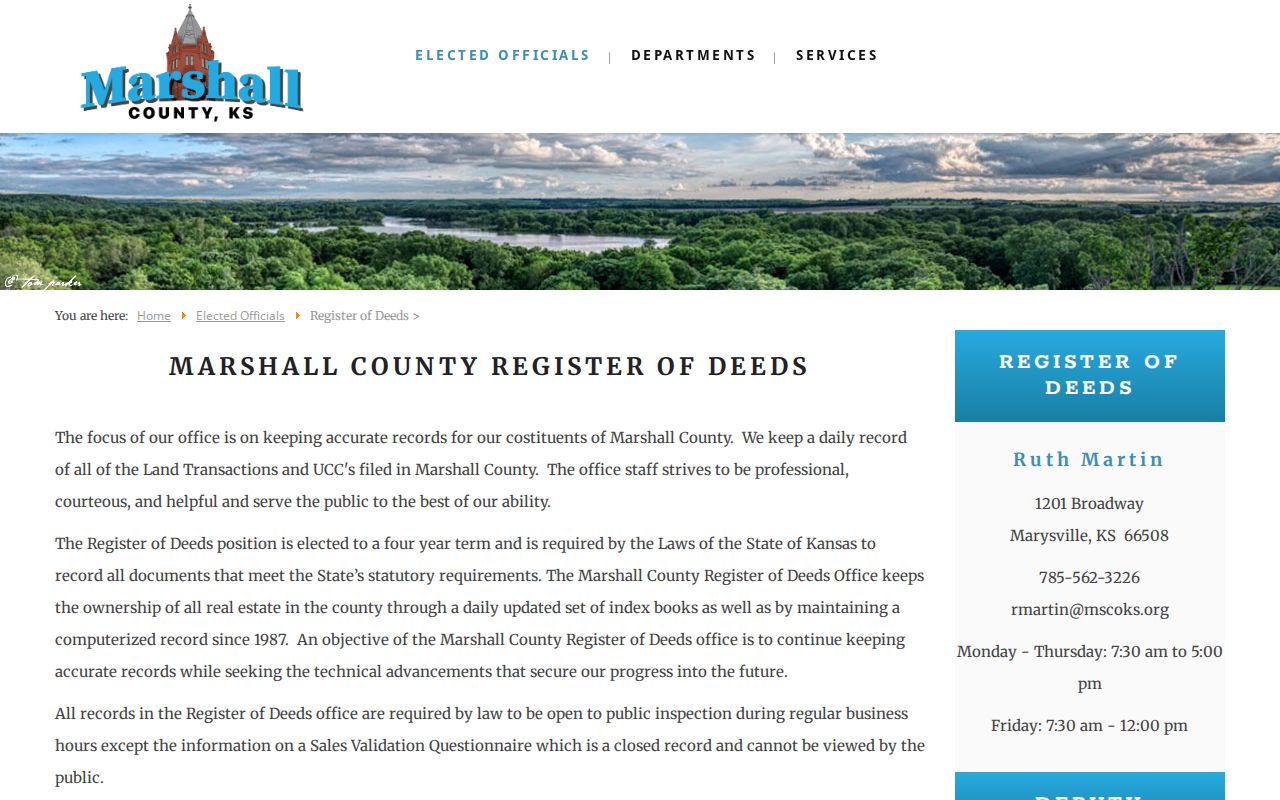
Per the county's own page, Marshall County deed searching rests on county indexes rather than any remote image portal. Build your research plan around that reality.
Historic Marshall County Deed Sources
State archives hold the earliest Marshall County deed material. A KSHS finding aid covers the indexed Land District Record. The Record spans 1858 through 1863, along with mortgage and release series. Ownership maps from 1904 and circa 1922 round out the set. The Marshall County Historical Society keeps local sources too. Its archives sit in the preserved 1891 courthouse. They occupy the building's former deeds office.
For the earliest land entries, the Land District finding aid is the key. It points researchers to microfilm MF 364.
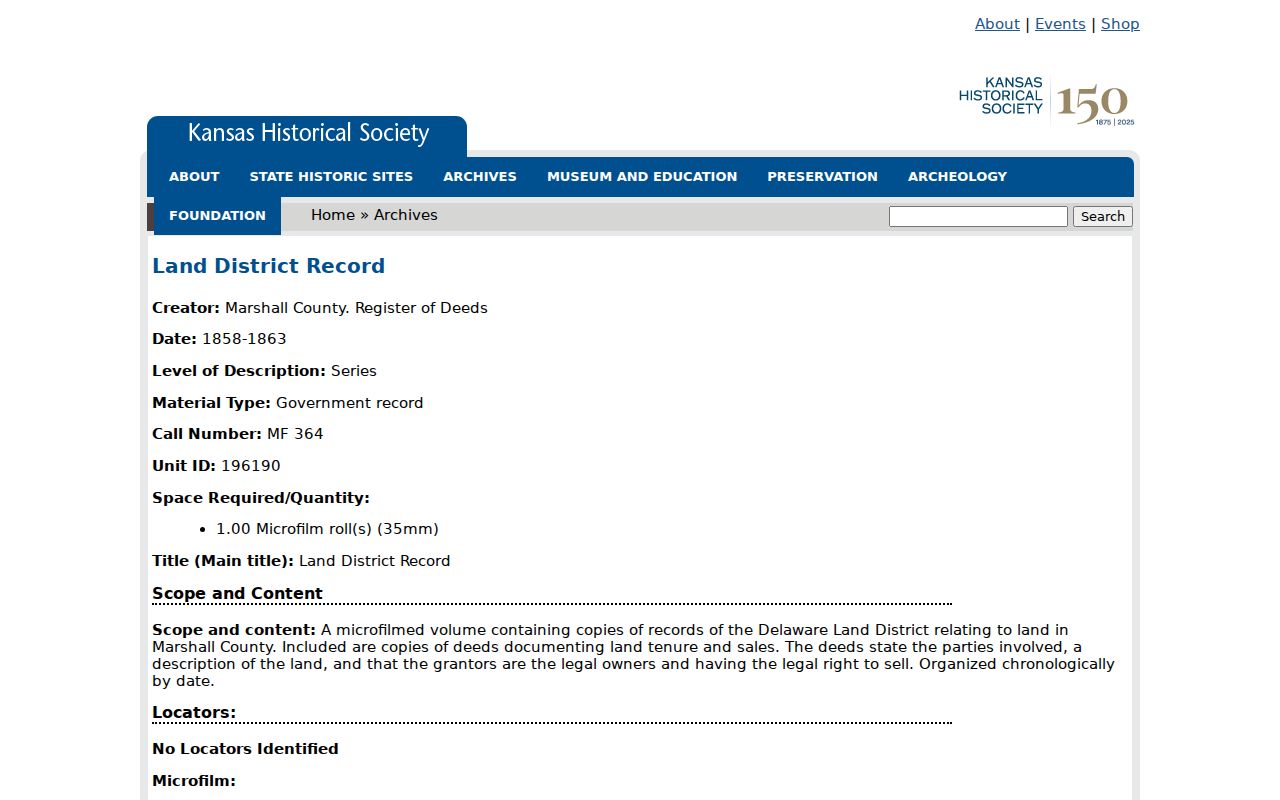
An archival clue is only a lead. Carry it forward through Marshall County deeds, probate, and shifting plats before counting it as part of a chain.
Marshall County Legal Descriptions Control
The appraisal description can differ from the recorded legal description. Use CAMA to find a tract. Copy the legal text from the deed itself. Town property often runs by subdivision, block, and lot. Rural Marshall County land uses section, township, and range or metes and bounds. Frankfort's sample shows Original Town, Block 6 with three book-page leads. Each instrument must be pulled to confirm its parties, date, type, and land conveyed. A block alone proves neither the lot nor the current boundary.
Marshall County Transfer Forms Stay Closed
Kansas requires a Sales Validation Questionnaire with many qualifying transfers. Marshall County treats that information as closed. Skip any promise of private sale details. Work from the public deed, any lawfully available recorded consideration, and appraisal data instead. The County Clerk validation page explains the requirement and the closure. It also lists the exemptions.
Match Marshall County Liens and Releases
Search mortgages, mechanics liens, tax liens, releases, assignments, and fixture filings under both sides of a Marshall County transaction. Look forward too. A satisfaction, correction, or assignment may touch the same legal description. An old lien hit says nothing about a current balance. Where a UCC filing lands depends on the collateral and the debtor. Fixture filings tied to land belong in county records. Other filings may sit elsewhere. Follow the office's written-search procedure. State the record type clearly.
Marshall County Estate Transfers
An executor, administrator, trustee, or estate can break a simple buyer-seller chain. Pull the deed first. Then search the District Court probate file for the appointment, petition, order, inventory, or distribution that explains the authority behind the transfer. The District Court Clerk holds that file. Match the case to the deed's legal description. A death certificate helps with identity, but Kansas vital records carry access limits and transfer no title on their own.
Verify Marshall County Deed Evidence
Treat every deed as evidence to be verified, not assumed. Save the instrument type, the execution date, the recording date, and the exact party spellings. Keep the fiduciary capacity, book and page, full legal description, return address, earlier references, and certification notes with each record. Before deciding an owner display is wrong, compare the record date against the CAMA update date. A gap you cannot prove should be labeled as a gap. Work through the office index, paper books, probate file, or archive instead. Never bridge a missing transfer with a shared surname or a neighboring lot. When contacting the office, be specific. The Register of Deeds sits at 1201 Broadway in Marysville, reachable at 785-562-3226 or `rmartin@mscoks.org`. Supply the grantor and grantee spellings, an approximate recording date, and the instrument type. Add any book-page lead and the full land description. Ask whether the copy should be plain or certified. Request a current fee estimate before mailing payment. The county fee schedule covers recording plus copy, mailing, and research services. Costs vary by request, so treat any old figure as unconfirmed. A narrow request also saves staff search time. If CAMA supplied the only citation, call it an appraisal-card reference. Ask the office to confirm the true instrument type and retrieval number.
Legal descriptions are what keep same-name parties from forming a false chain. For town land, compare the subdivision or original-town name, block, lot, any replat, and metes-and-bounds text. Rural land needs section, township, range, quarter section, government lot, acreage, monuments, and the point of beginning. Remember that CAMA tracts are sometimes shortened for tax work. The recorded instrument holds the title description. Parcel splits and combinations demand a parent-child trail. Save the old parcel number and legal description. Save new lot labels, the recorded plat, tax certification, and each deed conveying part of the tract. Marysville's rules permit suffixes like `4A`, `4B`, and `4A-1`. That pattern may explain why an early deed's simple lot number vanished from the current appraisal search. Mortgages and liens must be read forward as well as backward. After locating the original filing, search for assignments, modifications, releases, satisfactions, corrections, and related instruments under both party names. An old mortgage entry proves only that a document was recorded. It does not prove the debt is still unpaid. Match each release to its referenced mortgage and legal description rather than trusting similar names. Estate deeds need the authority behind the signature. When a personal representative, executor, administrator, or trustee conveys property, pull the deed. Also pull the probate orders, appointment, inventory, or distribution from the District Court Clerk. A death certificate may help separate identities. Kansas vital records carry eligibility limits, though, and the certificate never replaces the deed or court order.
The Sales Validation Questionnaire marks a firm public-access boundary. Marshall County states that qualifying transfers may require it, yet its contents stay closed. Use the public deed, any lawfully available recorded consideration, and the dated appraisal record for sale context. Never infer the questionnaire's contents from a later CAMA value. Do not expect the Clerk to disclose it under a broad request. Historic maps and archives support the chain without substituting for it. The 1904 and circa-1922 ownership maps can place old town blocks, township land, roads, and named owners. KSHS mortgage and land-district series extend the chronology further back. The Historical Society's local files may resolve a former place name or surname. Every clue must return to a recorded deed, probate instrument, or plat first. Only then does it become a verified transfer link. Keep recording dates and execution dates distinct. A deed may be signed long before it reaches the office. A CAMA update can also lag behind the recording. Save all three dates when available. If the current appraisal card and the deed disagree, check the legal description first. Then review parcel split history, correction instruments, entity or trust names, and the newest daily index entry. The county publishes no standard deed-to-roll lag.
Frankfort's historic Nottingham name deserves its own caution. KSHS records that the post office opened in 1869 after the name changed from Nottingham. An older census, map, or deed may use that earlier place name. Current tax records will still say Frankfort. Search both labels in historical sources. Then rely on the lot, block, section, township, range, and recorded calls to prove the same ground is involved. Close the deed worksheet with an evidence status for every link. Use one of five labels. Call it a verified instrument, an index-only lead, a parcel-card reference, an archival clue, or an unresolved gap. That simple label stops a CAMA book-page notation from being presented as a read deed. It also keeps a historic landowner map from posing as current title. A complete Marshall County deed records search stays transparent about what was inspected. It notes where it came from and what still needs retrieval.