
Fields in Marshall County Tax Records
Each Marshall County parcel has two records. They answer different questions. The Appraiser's covers identity, class, market and assessed value, and improvements, while the Treasurer's carries bills, receipts, payment history, special assessments, and delinquency, with the Clerk supporting the roll and levies.
| Field | What It Shows | Where |
|---|---|---|
| Market/appraised value | County estimate before class ratio | Appraiser card |
| Assessed value | Taxable value after classification | Appraiser |
| Land/building total | Components behind the appraisal | CAMA detail |
| Taxing unit | District code tied to the parcel | CAMA and tax record |
| Bill and payment status | Current or prior amount and receipt state | Treasurer portal |
| Special assessment | Additional parcel charge when applicable | Treasurer |
Assessed value is not a sale price. Kansas usually assesses homes at 11.5 percent. Confirm the class first, because the tax bill reflects levies and districts rather than any buyer's price.
Look Up a Marshall County Tax Bill
Start with the address. The official tax search also accepts identifiers, owner names, street fields, subdivisions, and section-township-range for rural parcels. Save the exact identifiers from any match.
- Search the Marshall County tax portal by situs or parcel.
- Confirm the CAMA number, owner, property address, tax type, and taxing unit.
- Open current and historical entries and record the year, amount, and payment status.
- Compare appraisal values in CAMA and contact the Treasurer about bills or special assessments.
- Assessed value
- The value to which tax levies apply.
- Mill levy
- The rate used to calculate property tax.
- Taxing unit
- The code tying a parcel to taxing jurisdictions.
- Tax lien
- A recorded claim arising from unpaid tax.
Protest a Marshall County Assessment
An informal meeting with the Appraiser comes first. Bring the valuation notice, parcel card, photos, corrected property facts, comparable sales, and repair evidence. Kansas also allows payment under protest. That route opens after the ordinary notice period. Local instructions set December 20 or January 31 depending on when taxes are paid, require the first-half payment, and continue to the Board of Tax Appeals.
Appeal window. Follow the date on the notice and current county instructions. Payment-under-protest timing depends on the tax-payment schedule.
Marshall County Tax Search Controls
The search form uses structured choices that cut false matches. Owner searches can target current owner, taxpayer, or both. Address fields split number, direction, street name, and ZIP. Town parcels match by subdivision, block, and lot. Rural ones use section, township, and range, and the official help page explains the eight-character owner ID, tax ID format, exact-name matching, and query narrowing.
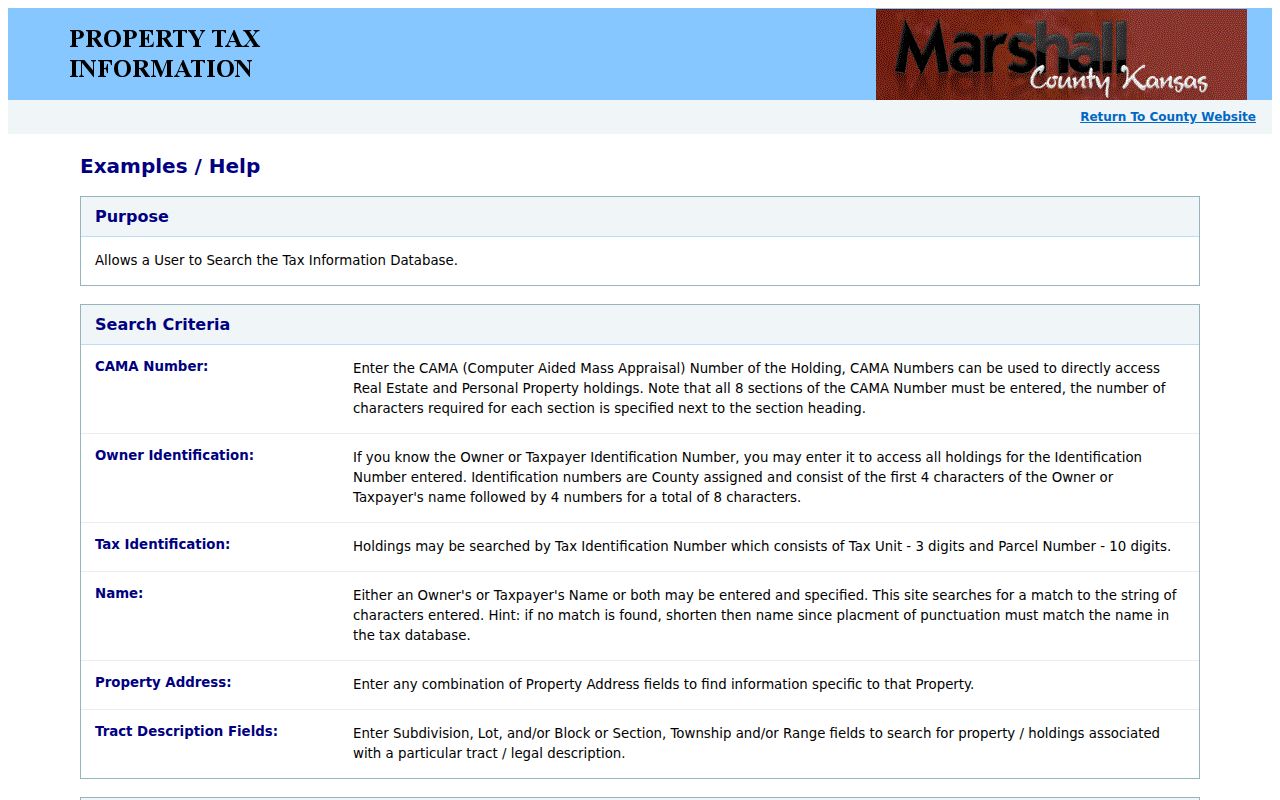
The screen flags dropped zeros, stray text, and wrong fields.
Marshall County Tax Portal Screen
The public entry offers real-estate and personal-property tax types. It also lets you pick current taxes or taxes due. That split serves an annual review as well as a delinquency check. The tax search form is the official starting point.
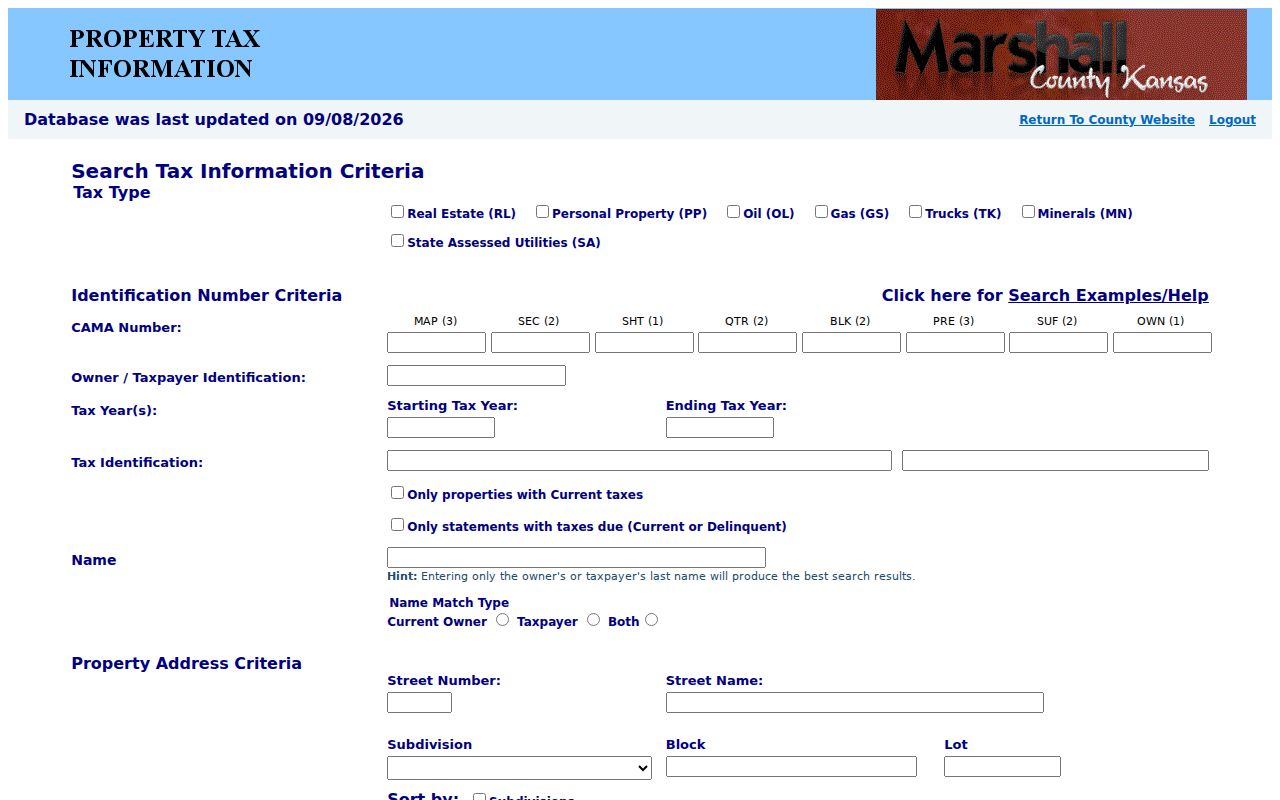
Keep the update date; records change on separate schedules.
Marshall County Appraisal Components
The inspected Frankfort card splits land, building, and total. It adds class, year built, area, basement, garage, utility, street, sidewalk, lot, and site factors. Such detail explains why neighbors' values differ. The sample parcel card posts 2026 land of $2,900, a building of $119,540, and a $122,440 total.
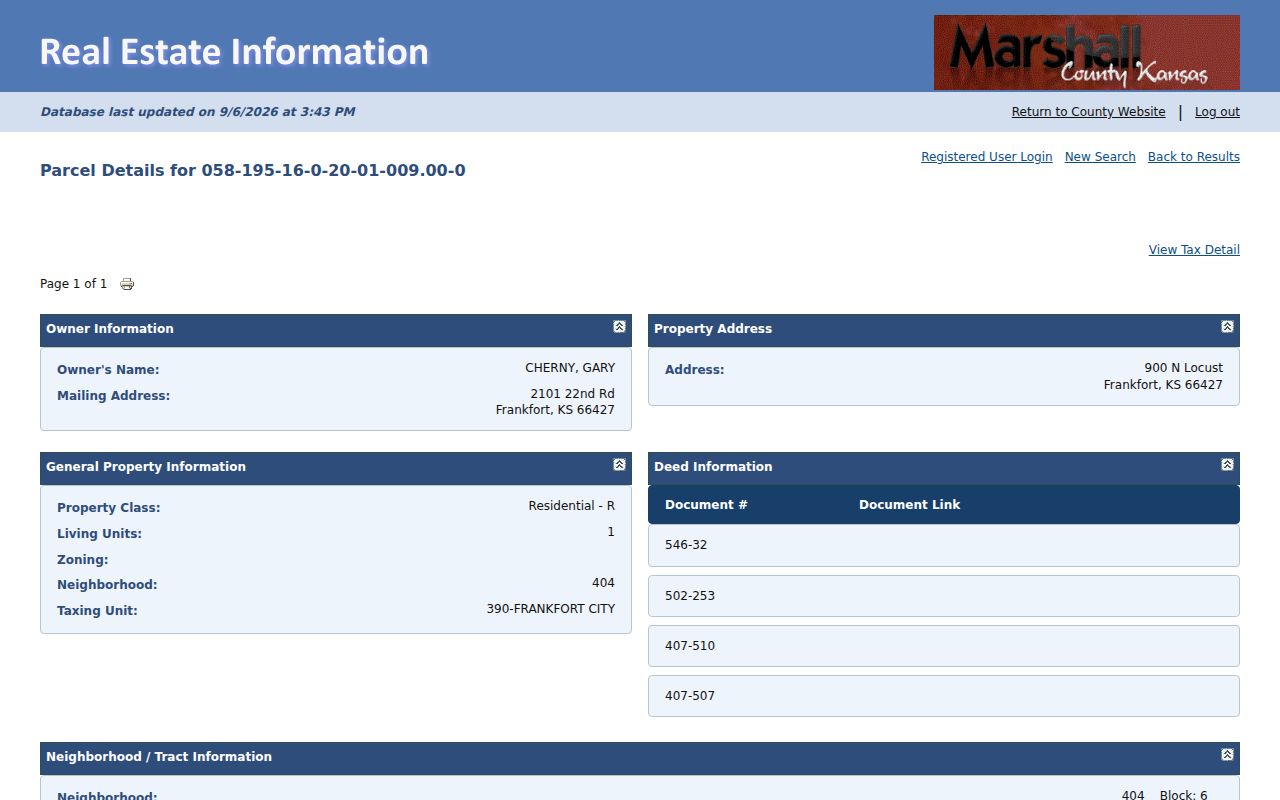
These figures fit one parcel, not a sale price.
Marshall County Values Refresh Annually
The Appraiser values real property as of January 1 and physically inspects each parcel on a six-year cycle. A new sale, improvement, condition change, classification change, or broader market evidence can affect the next value.
The Appraiser office publishes the valuation and inspection framework. Compare the annual appraisal date with the deed recording date and tax year. A later deed does not automatically change an already established valuation date.
Marshall County 2026 Market Signals
Marshall County's 2026 market study uses trend groups. Pre-1946 homes show 11.3 percent. Post-1945 homes trend 3.8 percent per year. Commercial sits at 3.7 percent, and vacant lots at minus 1.4 percent. These are study categories, not promises. Judge each parcel by its card's age, class, condition, land, improvements, and prior values. A 1976 Frankfort sample falls in the newer category, yet that alone cannot prove a 3.8 percent rise.
Marshall County Bills and Special Assessments
The Treasurer runs billing, collection, distribution, tax history, special assessments, and an escrow plan. Call that office about payments or receipts. It also handles bill addresses, installments, and special assessments. The Appraiser is the right office for parcel facts, class, or value. Delinquency can bring notices, tax liens, and sale procedures. A portal result alone is not a scheduled sale. Confirm status and deadlines with the Treasurer, and pull any recorded lien or court file tied to the legal description.
Marshall County Homestead Assistance
Homestead refunds and value protests are different paths. The County Clerk assists with Kansas Homestead Property Tax Refund applications. A refund is not a value change. Keep its eligibility proof, filing steps, and annual tax records separate from an appraisal protest, and the County Clerk page lists tax-roll, mill-levy, homestead, and open-records duties. Ask for current forms, not old copies.
Document a Marshall County Tax Protest
The county protest instructions set out the informal-meeting and payment-under-protest paths.
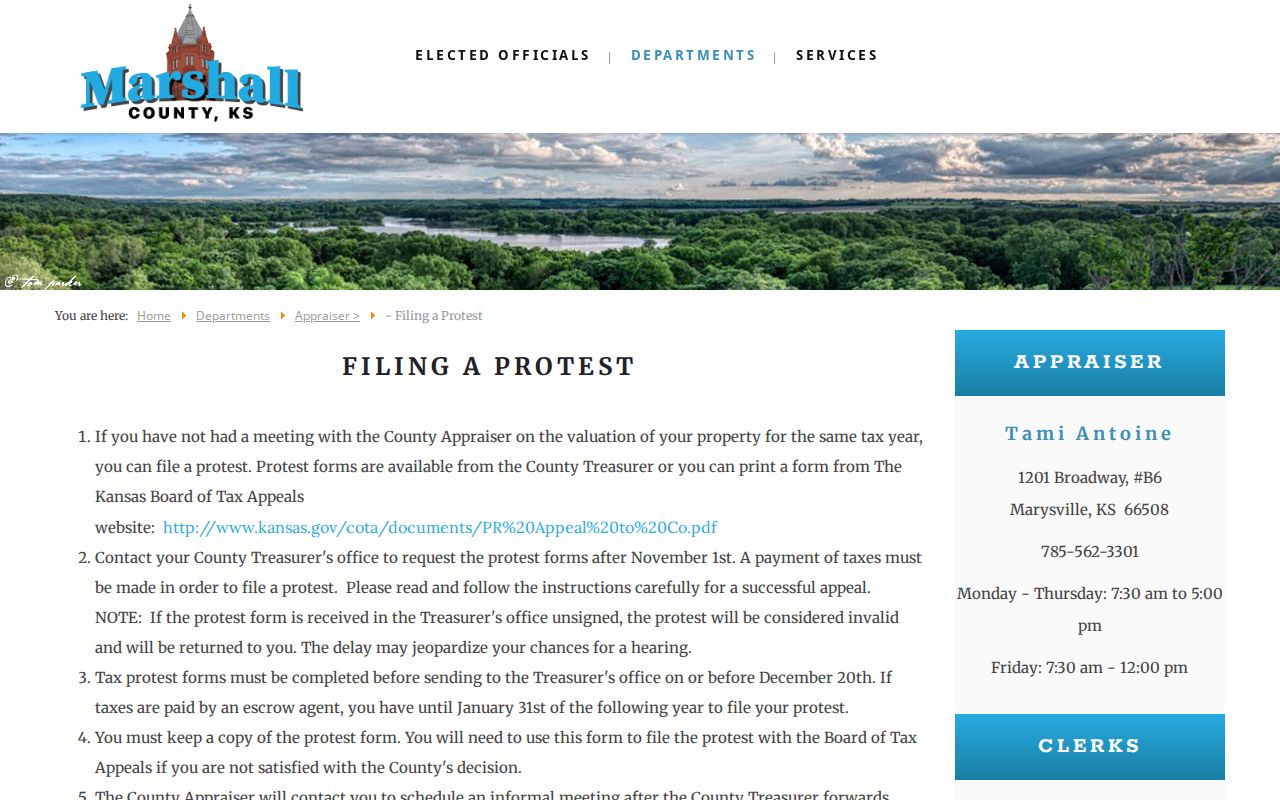
The local instructions lay out the current protest sequence. Unresolved appeals move on to BOTA. Build the packet with the notice, dated CAMA card, photos, measurements, deed date, permitted improvements, and comparable sales. Name the field you believe is wrong, request the correction, and keep proof of filing and payment.
What Marshall County Tax Records Cannot Prove
A property tax record does not prove marketable title, a surveyed boundary, occupancy, or a private sale term. The owner field is a dated administrative display. Confirm title through the recorded deed and boundary through a recorded plat and qualified survey work.
The Sales Validation Questionnaire submitted with many transfers is closed to the public. A public deed and any legally available consideration may provide sale context, but appraisal value, assessed value, tax due, and sale price remain distinct figures.
The tax search supports several paths because one key does not fit every parcel. Address fields separate street number, direction, name, and ZIP. Owner searches distinguish current owner, taxpayer, or both. Platted land can use subdivision, block, and lot, while rural land can use section, township, and range. CAMA, owner ID, and tax ID fields provide exact routes when those identifiers are already known.
Preserve identifier formats. The portal help describes an eight-character owner ID and a tax ID made from a three-digit taxing unit plus a ten-digit parcel ID. The sample CAMA number uses a longer segmented format and should not be confused with either one. Leading zeroes matter. A partial sale, combination, or new plat can also issue a new parcel number, so retain older numbers found on deeds and prior cards.
Classification comes before the assessment ratio. Kansas generally assesses residential real property at 11.5 percent of fair market value, but the correct class must be confirmed from the record. The resulting assessed value is then used with the applicable levies. A market-study percentage, an appraisal total, an assessed value, a tax bill, and a recorded sale price are five different facts and should never be merged into one value.
The 2026 Marshall County study illustrates class and age differences. It reports 11.3 percent for pre-1946 homes, 3.8 percent per year for homes after 1945, 3.7 percent for commercial property, and negative 1.4 percent for vacant lots. Those categories inform mass appraisal. They do not prove that each parcel changed by the listed amount, and they are not forecasts of a private sale.
Physical inspection and annual valuation work on separate cycles. The Appraiser values real property as of January 1 and inspects parcels on a six-year cycle. Between inspections, permits, sales, imagery, owner reports, and other data can signal changes. Review the card's year built, area, basement, garage, utilities, street, lot, and site factors. Report a wrong fact promptly because even a small factual error can affect classification or value.
The Treasurer is the right office for a bill, receipt, payment allocation, special assessment, escrow question, or delinquent status. The Appraiser handles parcel facts and value. The County Clerk supports tax rolls, mill levies, and Kansas Homestead Property Tax Refund applications. Sending the same general request to every office slows the search. State the parcel, tax year, exact field, and desired correction or copy.
Delinquency needs direct confirmation. A Taxes Due filter can identify records for closer review, but it does not by itself prove a scheduled tax sale or final redemption deadline. Contact the Treasurer for the current balance, interest, notice, and procedural status. Search the Register of Deeds for any tax lien or deed and the District Court for related litigation when the parcel's legal status is important.
A protest packet should focus on the appraisal issue rather than the amount of tax alone. Save the valuation notice, dated parcel card, property photographs, measurements, condition evidence, repair information, permitted improvements, deed date, and relevant comparable sales. Identify the field or method believed wrong. Keep proof of the informal meeting, filing, payment, and any appeal to the Kansas Board of Tax Appeals.
Record dates can explain apparent conflicts. The Appraiser login, sample CAMA card, and tax portal displayed different update events in late August and early September 2026. None publishes the lag from deed recording to owner-roll display. Compare the deed's recording date, January 1 valuation date, tax year, portal refresh, payment date, and access date before deciding that a record is stale.
Finally, tax geography is not boundary proof. The sample card's `390-FRANKFORT CITY` taxing unit is a useful district clue, but a taxing unit, postal city, ZIP, and incorporated limit are distinct. Match the situs and mailing addresses, use USPS for delivery ZIP, consult city-limit data where available, and retrieve the recorded plat or survey for land lines. A tax record exists to administer value and tax, not to settle every title or geography question.