
Trace Back Marshall County Former Owners
Take the most recent deed lead and step back through one recorded transfer at a time, grantee to grantor. Marshall County offers no remote grantor/grantee portal, and its property records span sources from distinct periods.
| Source | Years It Covers | Where Held | What It Shows |
|---|---|---|---|
| Computerized ownership index | 1987 forward | Register of Deeds counter | Grantor, grantee, instrument and recording trail |
| Paper index books | Earlier; exact start unstated | Register of Deeds | Prior conveyance references |
| KSHS land series | Selected series from 1858 | KSHS finding aids and microfilm | Land district, deeds, mortgages and releases |
| Plat books | 1904 and circa 1922 | KSHS and Kansas Memory | Historic landowners, lots and adjacency |
A modern chain starts with the current Register of Deeds. Territorial-era land history calls for a handoff to KSHS and local historical holdings instead.
Use the 1987 Marshall County Handoff
Per the Register of Deeds, computerized ownership records reach back to 1987, alongside daily index books. That year is only a technology threshold. Earlier former owners wait in paper indexes and historical series.
Coverage limit. Continue older work in index books, microfilm, and deed series rather than reporting that no prior owner existed.
Begin with Marshall County Deed References
The Frankfort sample parcel card gives book/page clues beside owner, parcel, and legal-description data.
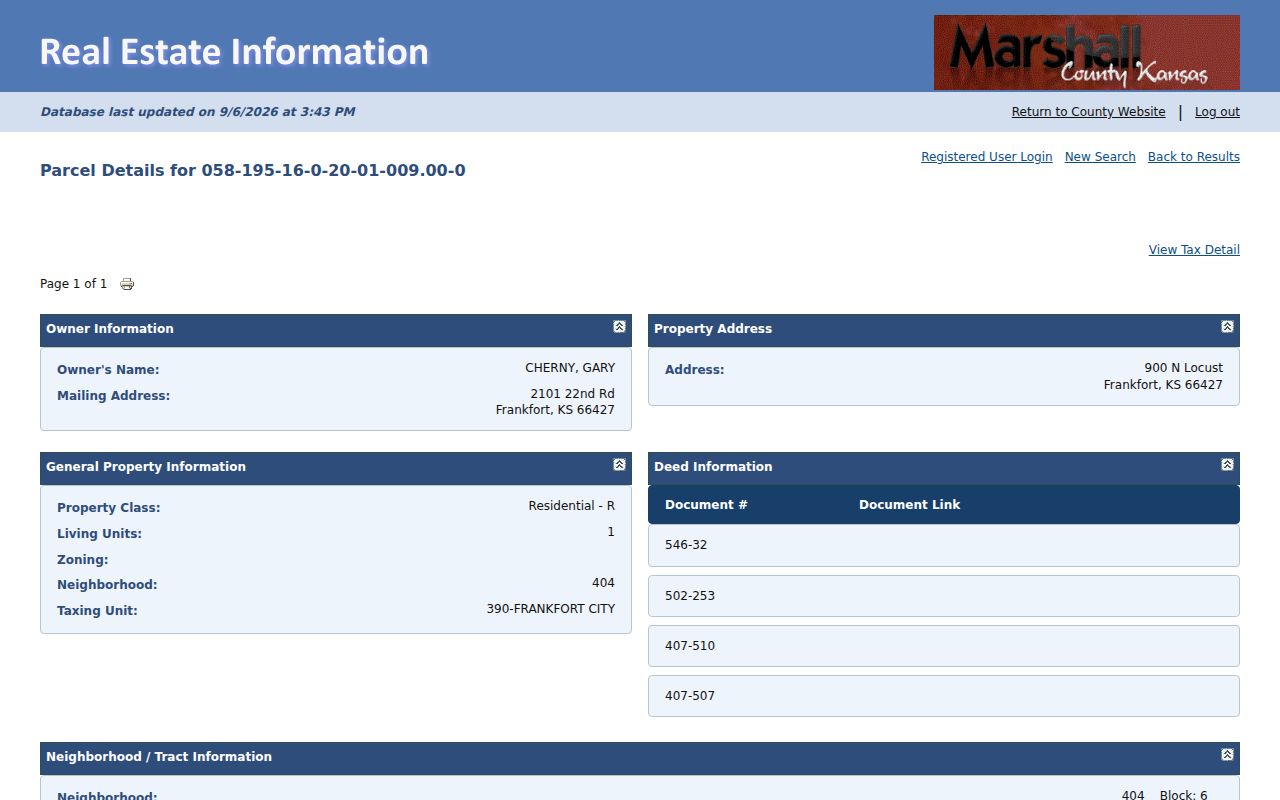
Treat any single deed reference as a launch point, not the chain itself. Verify each instrument, then keep moving through its grantor.
Reconstruct the Marshall County Chain Backward
Build a worksheet with one row per transfer. Every row should hold the names, dates, deed type, and book/page reference tied to the same legal description.
- Find today's owner's acquiring deed.
- Read its grantor, date, type, and legal description.
- Search that grantor as an earlier grantee and repeat.
- At 1987, continue in paper indexes and archive aids.
- Grantor / grantee
- The conveying and receiving parties.
- Reverse index
- The grantee route used to find acquisition.
- Chain of title
- The ordered sequence of recorded interests.
Sort Marshall County Deed Types
Warranty, quitclaim, executor, sheriff, trustee, correction, and tax deeds carry different legal weight. A quitclaim may only clear a claim. A correction can repair an earlier instrument with no sale at all. Read the parties, dates, descriptions, and later instruments before placing a deed in the timeline, and remember the confidential Sales Validation Questionnaire is no public substitute.
Extend Prior Owners into KSHS Series
The Kansas Historical Society aids catalog warranty deeds from 1858 to 1901, quitclaims from 1879 to 1902, and tax deeds from 1875 to 1908. Mortgages run through 1951. The 1858 to 1863 Land District Record sits on microfilm MF 364. It includes an 1858 to 1860 index. A catalog entry names the series and call number. It is not a guarantee that every page is online. Ask KSHS about reading-room or reproduction access.
Map Marshall County Owners Before Parcel IDs
Landownership in Marshall County goes back further than modern parcel numbering. The 1904 plat book lays out township and town plats. It names landowners. It adds a patrons directory for good measure. A circa-1922 atlas gives a second time layer. Any older label should still be reconciled against the deed description and the current parcel.
Parcel numbers are not permanent. Partial sales, combinations, and new plats can retire one entirely. Keep predecessor IDs and lot labels intact. Do not force a current address onto an older record.
Use the Former Marshall County Recorder Workspace
The Marshall County Historical Society library now fills the former Register of Deeds office in the preserved 1891 courthouse. Its town, cemetery, church, school, and genealogy holdings help sort similar former-owner names once a deed supplies a real lead. Local history is context, not a substitute for the conveyance. It shines where initials blur identities. The older Nottingham name for Frankfort complicates searches the same way.
Keep a Marshall County Transfer Timeline
Give the chain worksheet columns for transfer date, grantor to grantee, and instrument type. Add columns for book/page, legal description, and the source inspected. Note parcel-number changes separately. So should town-name changes and probate cases. This structure keeps a plausible family or place clue from being mistaken for a proven transfer.
Mortgage and release records can fill dates between ownership events. KSHS lists mortgages from 1877 through 1951. It also holds a release series from 1882 through 1904, both arranged by filing date. Entries may carry parties, consideration, land description, indebtedness, or default facts. A mortgage secures an interest, though. It does not by itself prove fee ownership.
Estate transfers need two linked checks. An executor, administrator, or guardian deed identifies the conveyance. A probate file explains the authority behind it. Confirm the deed was recorded. Confirm its legal description matches the property. A surname shared with a former owner is never enough.
For an old town property, search both the place name and its legal description. Frankfort's post office was formerly named Nottingham, so early references may use that older name. The town and block wording is the safer bridge to later parcel data.
Bridge Old Marshall County Descriptions
Old ownership research rarely stays at one modern address. Marshall County town land may sit under an original town name, subdivision, block, lot, replat, or a metes-and-bounds call. Rural parcels lean on section, township, and range. Quarter sections, government lots, tracts, and acreage narrow the description further. Copy every word of the description at each step, and note what never changed.
The County Appraiser builds a tax description. It can differ from the Register of Deeds legal description for the same parcel. Let CAMA point you to the parcel. Let the recorded instrument decide whether two transfers touch the same land. A deed may cover only an easement or a narrow right-of-way rather than the full fee.
Marysville's replat habits show why loose matching fails. A merged lot can take the lowest number plus A. A split can create lots 4A and 4B. A later split can add 4A-1. Keep those suffixes. They anchor a former owner to the right parcel. Rural land needs the same care with quarter and tract details.
When a street name or number fails, search the legal description, former owners, the current address, and a historic map together. Marshall County publishes no countywide street-renumbering history. Treat any claim of one as unproven. Ask the office for any address-assignment or road-name record it holds.
Handle Marshall County Chain Gaps
A tidy deed chain can break in several ways. Probate and a sheriff's deed are usual culprits. So are quiet-title litigation, a correction, a tax deed, or a parcel split. Pull the District Court file when a judgment or an estate drives the transfer. Then return to the Register of Deeds and see which instrument actually went on record.
County records stay open for inspection. Protected material such as the Sales Validation Questionnaire is the exception. A missing questionnaire value is not a missing deed. A KSHS catalog result works only as a finding aid. It proves nothing about a named owner's interest until you inspect the entry itself.
If no link emerges, record exactly what you checked. Note the indexes, date spans, name variants, call numbers, and descriptions. A documented gap is useful. Filling it with a likely relative, occupant, mortgage borrower, or nearby landowner would corrupt the former-owner chain.
Check Each Marshall County Former Owner Twice
A name belongs in the chain only under one condition. An instrument must tie that party to the same legal property. Confirm it in the index and the recorded deed. Watch for later corrections. Similar surnames in a census, cemetery file, or neighboring plat are identity clues, not conveyances.
Record every variant exactly. Initials, trust language, estate roles, and entity suffixes all count. That care makes the next reverse-index search reliable. It also keeps one person's Marshall County record from joining another's history.
Gauge How Far Marshall County Ownership Goes
Documented sources reach an 1858 Land District Record, and listed patents cover 1870 through 1884. Early work shifts fast. The material moves among districts, patents, deeds, and plats. No official source records a courthouse fire or a destroyed countywide series, so label any gap rather than inventing a loss.
Lawful use. Former-owner research supports house history, estate work, and purchase diligence. Never use historical names or addresses to track, harass, or harm anyone.