
Compare Marshall County Property Value Types
One parcel can carry several numbers that answer different questions. Keep the Appraiser's annual value, the class-based assessed amount, and any public sale consideration clearly separate when you compare Marshall County property records.
| Value | What It Is | Where |
|---|---|---|
| Fair market value | County mass-appraisal estimate as of the valuation date | Appraiser record |
| Assessed value | Market value multiplied by the constitutional rate for the property class | Appraiser and tax roll |
| Last sale price | Consideration tied to a prior transaction, when publicly shown | Recorded deed or available transfer record |
| Land / building / total | Components used on the parcel card | CAMA detail |
Residential tracts in Kansas commonly use an 11.5% assessment level. Other classes carry other constitutional rates, so the parcel's actual class, not habit, controls the math in every Marshall County appraisal record.
Read the Frankfort Marshall County Value Split
The official sample CAMA detail breaks one Frankfort parcel into land at $2,900 and building at $119,540. The total value reads $122,440, and the same record lists property and building characteristics.
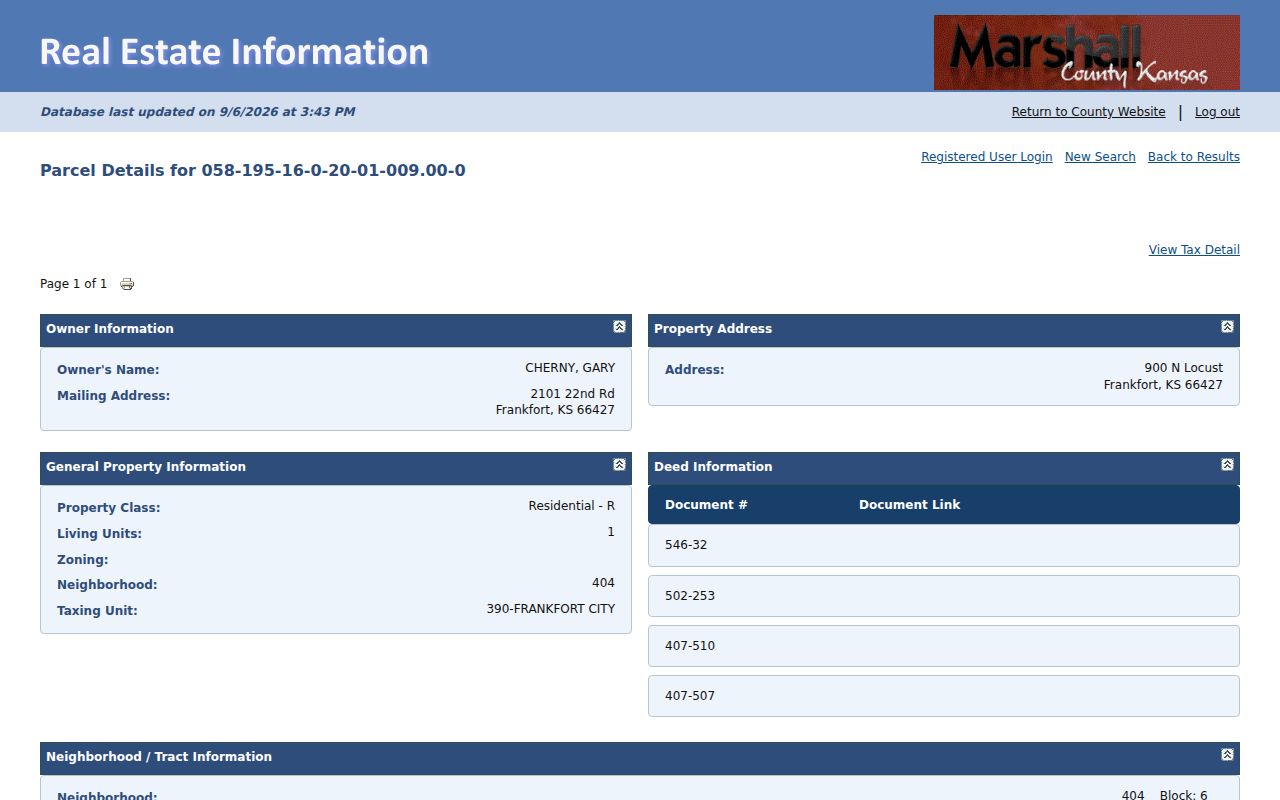
That breakdown describes one Frankfort parcel, not the county. Carry its class, valuation year, and update date whenever these figures meet another parcel in a Marshall County property search.
Apply Marshall County's Assessment Level Carefully
K.S.A. 79-1439 governs fair-market appraisal and classification in Kansas. Residential property uses 11.5% as its common assessment level, but agricultural, vacant-lot, commercial, and other classes each follow different rates.
Value terms: Market value is the Appraiser's full-value estimate, and assessed value applies the class rate to it. Sale price is transaction consideration, and reassessment is the recurring update of the county value record.
Check classification before running any calculation. A tax-bill amount folds in levies, so it is not another form of property value.
Estimate a Marshall County Property Value Record
Open the dated assessment record with the parcel's address or CAMA identifier. The goal is to understand what each figure means in the deed and appraisal records, not to turn it into a promised sale price.
- Find the parcel in the Public Appraiser Portal.
- Record the value year, class, land, building, total, and update date.
- Apply only the assessment level for the displayed class.
- Check the recorded deed separately for transaction context and its date.
- Assessed value
- The class-adjusted amount used in taxation.
- Market value
- The county's mass-appraisal estimate.
- Assessment level
- The statutory ratio for the property's class.
Use the January 1 Marshall County Value Date
The Appraiser revalues property annually as of January 1 and physically inspects or remeasures real property at least once every six years. Building permits and mapping changes can also affect the record.
A partial sale, parcel combination, or new plat may cause a new parcel ID. Compare the value year and parcel identity before treating two totals as a trend.
Note: Annual revaluation does not mean every physical feature is inspected each year; the county states a six-year inspection cycle.
Understand Marshall County's 2026 Market Signals
The Appraiser's 2026 market study reports an 11.3% inflationary trend for homes built before 1946. Homes after 1945 show 3.8% per year. Commercial property sits at 3.7%, while vacant lots carry a 1.4% deflationary trend. These figures describe broad study categories. They guarantee nothing for a specific parcel. Class, age, site, condition, size, utilities, garage, and other improvements must come from the parcel's own record.
Interpret Marshall County Site and Improvement Factors
The sample card lists year built, living area, garage, utilities, lot size, tract, acreage, and property-class detail. Facts like these explain value differences. Two nearby parcels can receive different values even when their addresses look alike. A blank zoning field on the Frankfort card proves nothing about zoning itself. CAMA is an assessment record. Municipal zoning and permit files live in separate sources. So keep value evidence within its proper record system.
Separate Recorded Sale from Confidential Validation
Kansas requires a Sales Validation Questionnaire for many transfers unless an exemption applies. Marshall County states the questionnaire information is closed. The public deed remains the transaction lead in the recorder's records. Deed type matters too. Gifts, corrections, trust transfers, and sheriff's deeds rarely offer an ordinary open-market comparison. Other exempt or special transactions rarely do either. Never fill a missing sale amount from the closed questionnaire.
Date Every Marshall County Value Comparison
The CAMA database posted an August 31, 2026 refresh. That date marks when the public system was updated. It is not when a particular sale occurred or what a buyer would pay today. For any value-history comparison, save the January 1 valuation year, portal update date, parcel ID, class, and deed recording date. Splits and combinations deserve extra care. Compare parent and child parcels cautiously before calling anything a trend.
Audit a Marshall County Value Comparison
Before comparing two property values, confirm both records share the same valuation year. Also confirm the correct parcel. Write down the property class, market value, assessed value, land component, building component, and total. Add the acreage or lot size, year built, living area, and update date. A bare total hides the facts that may explain the difference. Use the Property Address for the subject land. Keep the Mailing Address out of the geographic comparison. Treat the taxing unit only as a tax-geography clue. Two parcels inside one unit may differ in age, condition, improvements, utilities, garage, tract size, or other CAMA factors. For a past sale, record its date and deed type. An ordinary market sale, gift, trust transfer, quitclaim, sheriff's deed, or correction can each carry different meaning. The closed Sales Validation Questionnaire blocks any public shortcut. Do not infer consideration that the deed or another open record does not supply. Finally, state the purpose of the comparison. The assessor figures explain county valuation and assessment. They do not supply a private appraisal, a future sale price, or a legal boundary. Nor do they offer a building inspection or a title opinion. Holding that line keeps a property value lookup useful. It avoids overstating what the assessor, recorder, and deed records can actually tell you.
Get Marshall County Value Records Offline
When the CAMA portal is down, you can request the existing parcel card from the Appraiser at 1201 Broadway, room B6, in Marysville. The office lists 785-562-3301, with hours Monday through Thursday from 7:30 a.m. to 5 p.m. and Friday from 7:30 a.m. to noon. Bring the situs address and the exact parcel ID.
A deed tied to a sale belongs to the Register of Deeds, so contact that office with the party name, approximate date, legal description, and any book or page clue. Tax-roll and mill-levy questions go to the County Clerk. Each Marshall County office answers a different part of the value question.
KORA works for a specific existing value record. The agency may charge reasonable actual costs for staff time, copies, or postage, and it does not have to create a new analysis. Ask for the dated card, study, or named record rather than a custom estimate.
Keep Marshall County Value and Tax Roles Separate
Value and tax are two different jobs in Marshall County. The Appraiser sets market and assessed values. Taxing agencies set the levies. The Treasurer then bills and collects the tax. A bill can shift because of value, a levy, a special assessment, or several factors at once, so value research should end with the meaning and source of each figure. When the question is a bill amount, a delinquency, an exemption, or a protest, follow the separate tax procedures the Treasurer, County Clerk, and Appraiser each publish.
Read Vacant-Lot Values in Marshall County Context
The 2026 study puts vacant lots in their own category. Marshall County reports a 1.4% deflationary trend for vacant lots. Older homes, newer homes, and commercial property all show inflationary movement. That contrast is a warning. One countywide headline cannot be applied to every parcel. Start by confirming the property class. Also check whether CAMA carries a building component for the parcel number you hold.
That trend cannot settle one site's value. Acreage, location, access, utilities, plat status, and other recorded site factors differ from parcel to parcel. Use the parcel's own dated record. Treat the study percentage as market context rather than a formula for revising the displayed total in the property records.
Know What Marshall County Property Value Cannot Prove
The assessor's figure is a dated mass-appraisal value inside the property-tax system. Keep that date attached to every comparison. It is not a promise of sale proceeds. Nor is it a boundary survey, a title opinion, or a private appraisal. A tax bill is not a sale price either. For bill amounts, exemptions, and protest procedure, use the county tax records, and for a transaction decision, bring in a qualified appraiser and current market evidence.
Value versus price. A Marshall County assessed value serves taxation and is not what the property will necessarily sell for. It is not an independent appraisal.