
Identify Who Owns a Marshall County Property
Begin with the situs address instead of guessing at who lives there. Marshall County splits discovery, assessment, and title among separate records. Each source that agrees with the others makes the answer stronger.
- Enter the street number, street name, direction, and ZIP in the Marshall County tax search.
- Open the matching CAMA card and read the exact Owner's Name, Property Address, Mailing Address, parcel number, and update date.
- Carry the name, parcel description, and deed-reference lead to the Marshall County Register of Deeds.
- Confirm the grantee and legal description on the latest recorded instrument, then check for a later correction or transfer.
This path keeps the quick tax-roll display distinct from recorded title evidence, which is exactly the distinction that matters. If an address search stalls, try the tax portal's subdivision, block, and lot fields for town land. Rural parcels respond better to section, township, and range.
Marshall County's Owner Field Is a Starting Point
The Public Appraiser Portal carries the current CAMA record. Look for the Owner's Name field. The card also lists the property address apart from the tax-mail address, which keeps a lookup from drifting onto the wrong parcel.
Record terms: An owner of record is the name on an official roll. A grantee receives an interest by deed. Situs is the physical property address. The mailing address is where tax notices go. Title is the legal interest itself, not a portal label.
The sample Frankfort card shows the split clearly. Its property address reads 900 N Locust, yet its mailing address reads 2101 22nd Rd. Different mail destinations are common and do not mean the wrong parcel turned up.
Note: Copy every identifier exactly, including leading zeroes, hyphens, suffixes, book and page references, and the record-update date shown.
Sources That Trace a Marshall County Property Owner
No single public source answers every ownership question. The tax roll finds a name fast, deed records document the conveyance itself, and map data links an address to the right parcel.
| Where ownership appears | What it contributes | Freshness and access |
|---|---|---|
| Appraiser CAMA card | Owner's Name, mailing and property addresses, CAMA ID, value, deed leads | Free public route; database refreshed August 31, 2026 |
| Tax search | Address, owner/taxpayer, CAMA, owner ID, tax ID, subdivision or rural search | Remote portal; page updated September 3, 2026 |
| Register of Deeds | Grantee, grantor, recording date, legal description, later instruments | Counter inspection; computerized since 1987, index books earlier |
| ORKA resources | Possible address, road, city-limit, lot/block, subdivision context | Statewide service; Marshall parcel coverage is not confirmed |
An occupant, a tax-mail recipient, and the record owner can be three different people. The record answers the ownership question only as far as the latest reliable instrument reaches.
Confirm Marshall County Ownership at the Deed Counter
Marshall County publishes no county-specific remote grantor and grantee image search. The Register of Deeds counter sits at 1201 Broadway in Marysville, open Monday through Thursday from 7:30 a.m. to 5 p.m. and Friday from 7:30 a.m. to noon. Call 785-562-3226 or email rmartin@mscoks.org before an office visit or written request. Give the clerk the displayed owner, the parcel number, the city or township, legal-description clues, an approximate transfer date, and any book and page reference from the card.
Then inspect the newest matching conveyance and confirm its property description matches the subject parcel. A correction deed, trust transfer, sheriff's deed, or later conveyance can change the answer. Read the newest instrument before settling on a name.
Recorded proof matters. An assessor name is not a title search. Confirm the latest deed and any later instruments before relying on who owns a Marshall County property.
Read the Marshall County Parcel Card in Context
The sample parcel card below comes from the official county system and shows the record type behind this method. Open the live Marshall County sample property card to see its fields firsthand. Use those fields as search clues from there.
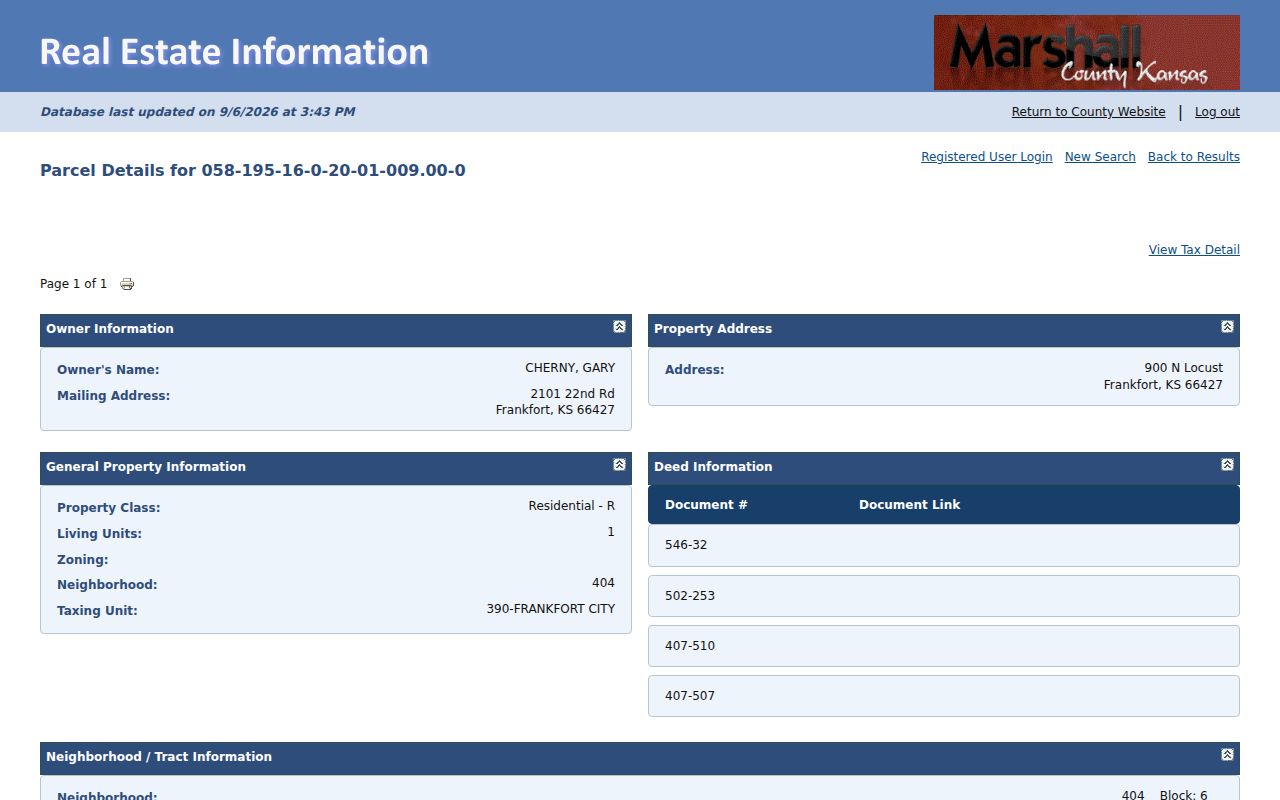
One dated record ties Owner's Name to the property address, mailing address, parcel number, deed references, improvements, and values. That combination separates a true parcel match from a similar owner name. Match several fields, not just one.
Entity, Trust, and Estate Owners in Marshall County
A CAMA card may list an LLC, corporation, trust, estate, trustee, or personal representative instead of a person. Keep that name exactly as displayed when you request the deed. Never quietly swap in a member, beneficiary, or occupant.
For a business grantee, the Kansas Secretary of State Business Entity Search accepts a business name, state business ID, or resident-agent name. It can identify the filed entity behind the grantee label. It still does not replace the deed. Estate disputes and contested claims may point to the Marshall County District Court file.
Note: A trust or entity label can be valid ownership evidence. No individual needs to be named on the tax roll for it.
Compare Marshall County Record Dates
The public CAMA database reports an August 31, 2026 refresh. The tax search shows a September 3, 2026 update. Those dates reflect system freshness only. Marshall County publishes no fixed lag between a deed's recording and the Owner's Name change on the assessment roll.
After a recent sale, compare the card's update date against the deed's recording date. A newer deed is the stronger current lead. Ask whether any later instrument has been recorded since. If the legal descriptions clash, resolve the parcel, lot, block, tract, or section reference first. Only then decide who owns this property.
Use Court Files for Marshall County Claim Disputes
Quiet-title, probate, foreclosure, partition, and sale-confirmation cases can explain why two ownership sources disagree. The Marshall County District Court holds the complete local file and pleadings. Statewide Kansas Courts Search may help with docket discovery. The county file is still the one that matters.
A court order is only one link in the proof chain. Check whether the resulting deed, sheriff's deed, executor's deed, or other instrument was actually recorded. Ask for a specific case or document rather than a fresh ownership report.
Prepare a Marshall County Ownership Request
A records request lands well when it points to a specific record. Give the Register of Deeds a precise property key. Include the owner of record if known. Add the situs, CAMA number, tax unit, and lot and block or section-township-range. An approximate transfer date helps, and so does any book/page reference. Say exactly what you need: an index entry, a recorded instrument, a parcel card, or a court filing. A narrow ask gets a fast answer in Marshall County.
Inspection hours run Monday through Thursday from 7:30 a.m. to 5 p.m. Friday hours are 7:30 a.m. to noon. Call 785-562-3226 or email rmartin@mscoks.org. Walk-in inspection is not the same as a remote image portal. Plan for copy or staff research fees.
Another county office may hold the record you need. Route a KORA request through the Marshall County Clerk in that case. Kansas agencies generally answer within three business days. They produce the record, quote a timeline, or explain a delay or denial. The law does not oblige a custodian to chase an open-ended ownership question. It need not trace a deed chain, or build a custom report from property records. Ask for something that already exists.
Keep a source log as you work through Marshall County property records. Note each URL or office, the access date, and any displayed update date. Copy every identifier from the deed or parcel record. That log lets you explain why the assessor and deed answers differ. It also makes the property search easy to repeat after a database refresh.
Save the Marshall County Owner Evidence
Save more than a copied name. Keep the full parcel card and the deed citation with the date you checked it. Include the situs, parcel number, legal description, update date, grantee, recording date, and any later instrument searched. Marshall County property records refresh on their own schedule. Stored evidence keeps your conclusion reproducible afterward. It also shows plainly whether the answer rests on the assessment roll or on recorded deed records.
Limits on Who Owns a Marshall County Property
Property records answer one question well. They name the recorded or assessed owner of a Marshall County parcel. They cannot show who lives there. They cannot show who is visiting. They also cannot show whether every private agreement has been settled. Kansas Safe at Home adds a wrinkle. The program can place a substitute address in state and local records for eligible participants. So never treat a mailing address as a clue to physical location.
KORA backs requests for existing records. It generally requires an agency response within three business days. It does not force any office to write a custom report. Ask for an existing parcel card, index entry, deed, or docket paper. Give enough detail that staff can locate it in the recorder's or assessor's files.
Lawful use. Marshall County owner information supports purchase research, boundary work, estate questions, and civic review. Never use it to stalk, harass, intimidate, or harm anyone.